A picture speaks more eloquently than a thousand words.
As the Muslim population of The Netherlands is increasing they diverse Muslim ethnic and sectarian groups commission the building of places of worship: Mosques. Some of them are in old schools of churches and some of them specially designed as Mosques, striking markers of the takeover of Dutch neighbourhoods. The Ethnic Dutch call them "Hovels of Hatred" (Haathutten).
Growing up a young Dutchman sees images on TV of the Middle East, North Africa and Central Asia, the areas were Islam is strong and were the Mosque is a part of the local architecture. Little does the Dutchman expect to find these elegant buildings in his own cities.
When I visit Rotterdam with a passenger I like to get off the highway. Into the Spangen neighbourhood. As I turn through the cobbled streets of this working class neighbourhood we get into a street running towards a canal. The street is narrow and all the 4-story apartment buildings have sattelite dishes, a marker of immigrant populations. Beyond the canal, filling the full width of the street is the
Mevlana Mosque.
On the streets little Arab and Turkish boys are playing "soldier" and the pavements is filled with veiled and burqa'ed women pushing wheel prams.
For most people the scene is a bit much to take in. They suddenly stop talking about whatever it was they were talking about and take a sharp hissing breath. Their eyes open wide and they look at the sattelite dishes, the lads, the prams, the burqas and the mosque.
A picture
says more than a thousand words.
In Amsterdam, the Turkish Milli Görüs movement has been raising funds to build a show-piece mosque in Amsterdam-West, in the De Baarsjes borough. On the site of a former factory a Mosque will be build in combination with one-hundred-eleven apartments, seven-hundred-sixty square meter set aside for offices and shops, one-thousand-forty square meter of meeting rooms for "societal purposes" and a parking with room for two-hundred-thirty-eight cars. On a long canal called the Kostverloren canal.
It will boast the highest minaret in The Netherlands. Forty-two meters high. It MUST be forty-two meters high according to the golden rule. In order to place the top of the minaret at a 45 degree angle with the dome of the mosque. It will be higher than the
Munt tower.But lower than the
tower of the
Westerkerk. The mosque will be build in the style of the "
Amsterdamse School" of architecture to make it fit in the surroundings.
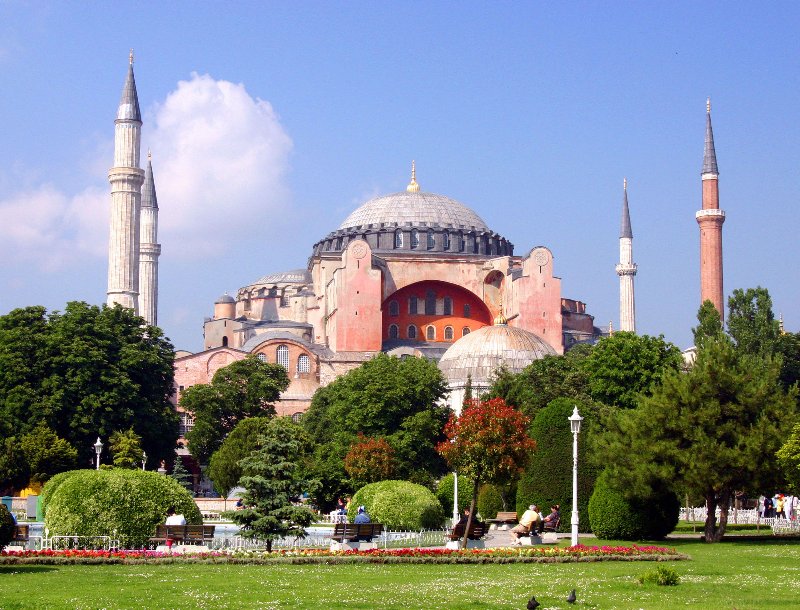
A final detail. The
design is fundamentally inspired by the design of the "Aya Sophia" church, the main Church of the Byzantine Empire. This grand church was turned into a mosque in 1453, when Constantinopel became Istanbul. The capital of a mighty Islamic empire that ruled from Morocco to Croatia and from the Tigris to the Danube.
The commissioners of the mosque put special emphasis on this piece of history.
Anyway a picture
says more than a thousand words.
So if I want to shock people with a
picture of the Islamification of The Netherlands, I do not have to go to Rotterdam anymore. Who said progress is a thing of the past?
The old has to make place for the new. A long time ago, in the 17th century the factory site on the Kostverloren canal was already an industrial site. The site was occupied by a windmill for milling wheat. The windmill was called: "Eendragt". That is "Unity". That mill went a long time ago. In 1842.
Something else that had to go was a monument that had been placed on the quay of the canal. A monument were Dutch people gather to remember those who were killed by the German occupiers in the Second World War. According to the borrough the Islamic and Jewish communities had requested the removal of the monument, because it had the shape of a Christian Cross. When asked the local Jewish community said they had never asked anything and to be displeased that their monument was removed. The had also been miffed when Morroccan lads had been kicking the wreaths just after the wreath laying ceremony in 2003. The Turkish, Moroccan and Pakistani communities have
confirmed (Dutch) that they asked for the removal of the offensive Cross. They do not like Christian symbols near their mosque.
O well. I got a monumental Mosque now. With a shopping centre. My cup runneth over.
And a picture
says more than a thousand words.